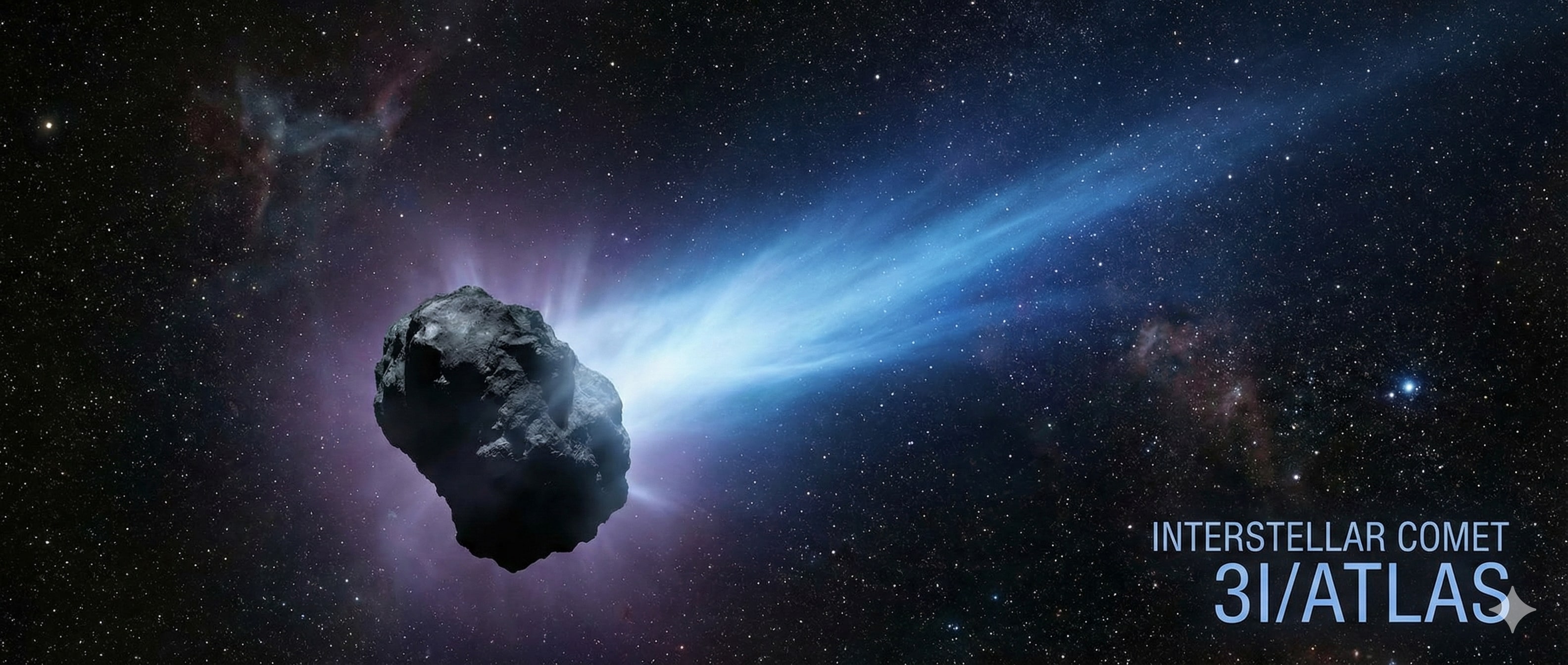
01 What Is 3I/ATLAS?
3I/ATLAS (also designated C/2025 N1) is an interstellar visitor — an object that originated from outside our solar system and is passing through on a one-way trip. It will never return.
The "3I" designation means it's the third confirmed interstellar object ever detected, following:
- 1I/'Oumuamua (2017) — a mysterious elongated object, possibly rocky
- 2I/Borisov (2019) — showed cometary activity
- 3I/ATLAS (2025) — the largest and most anomalous interstellar visitor observed
Key Question
Institutional sources classify 3I/ATLAS as a "comet" based on outgassing activity. However, multiple documented anomalies challenge this classification. See Section 09.
02 Discovery
Discovered
July 1, 2025
Discovered By
ATLAS Telescope, Chile
Pre-Discovery Observations
Back to June 5, 2025
Confirmation
Hyperbolic trajectory confirmed within hours
The ATLAS (Asteroid Terrestrial-impact Last Alert System) is a NASA-funded network of telescopes designed to detect potentially hazardous asteroids. The object's unusual trajectory immediately flagged it as potentially interstellar, later confirmed by orbital calculations showing it's moving too fast to be gravitationally bound to the Sun.
03 Physical Properties
Nucleus Size
440m – 5.6km
Upper limit from Hubble observations
Estimated Mass
>33 billion tons
Based on size estimates
Orbital Eccentricity
~6.3
Highest of any known interstellar object
Closest to Earth
1.8 AU
On Dec 19, 2025
Confirmed Composition (via spectroscopy)
These compounds have been detected via spectroscopy. JWST, VLT, and Swift Observatory confirmed these signatures. Methanol release rate: ~40 kg/second. Notable anomaly: only 4% water content (far below typical).
04 Trajectory & Timeline
July 1, 2025
Discovery
First detected by ATLAS telescope in Chile
October 3, 2025
Mars Closest Approach
29 million km from Mars — observed by Mars Express and TGO
October 30, 2025
Perihelion (Closest to Sun)
1.36 AU (203M km) — Speed peaked at 246,000 km/h (≈ NYC → London in under 2 minutes)
December 19, 2025
Earth Closest Approach ← WE ARE HERE
1.8 AU (270M km) — Nearly twice the Earth-Sun distance
March 2026
Crosses Jupiter's Orbit (outbound)
Leaving the planetary region of the solar system
~2030s
Exit Solar System
Returns to interstellar space, never to be seen again

Hyperbolic trajectory — 3I/ATLAS will never return
05 Who Is Watching?
3I/ATLAS is being observed by an unprecedented number of space missions and ground observatories:
Hubble Space Telescope
High-resolution imaging
James Webb (JWST)
Infrared spectroscopy
ESA Juice
En route to Jupiter
Mars Express
Mars orbit observations
ExoMars TGO
Trajectory refinement
XRISM / XMM-Newton
First X-ray observations
Swift Observatory
UV/X-ray
VLT (Chile)
Ground spectroscopy
NASA PUNCH
Solar wind interaction
First of its kind
3I/ATLAS is the first interstellar comet observed in X-rays (by XRISM and XMM-Newton in November 2025), revealing a diffuse X-ray glow around the nucleus.
06 Is Earth Safe?
✓ Yes. Completely Safe.
- • Closest approach: 270 million km — nearly twice the Earth-Sun distance
- • The comet cannot influence Earth physically, gravitationally, or electromagnetically
- • It absolutely will not hit Earth
- • NASA, ESA, and all major space agencies confirm: no danger whatsoever
07 Why It Matters
Every planet, moon, asteroid, and comet in our solar system shares a common origin — the same cloud of gas and dust that formed 4.6 billion years ago.
Several teams have reported molecules like methanol (CH₃OH) and cyanide-bearing species (CN) in its coma. These are common ingredients in prebiotic chemistry—the kind of complex organic building blocks that help scientists study how chemistry varies between star systems.
Interstellar comets are different. They carry material from other star systems, formed under different conditions, possibly billions of years before our sun existed. NASA estimates it may have traveled through interstellar space for about 7 billion years before arriving here.
Studying its composition tells us about the chemistry of distant stellar nurseries — places we can never visit, but whose messengers occasionally pass through our neighborhood.
"These comets are absolutely foreign. Every planet, moon, asteroid, comet and lifeform in our Solar System share a common origin. But interstellar comets are true outsiders, carrying clues about the formation of worlds far beyond our own." — European Space Agency
09 Documented Anomalies
⚠️ This object is NOT behaving like a typical comet
Even mainstream astronomers acknowledge unexplained anomalies. Penn State astronomer Jason Wright confirms 4 anomalies "have planetary scientists interested."
Persistent Anti-Tail
Points TOWARD the Sun — not a perspective effect like solar system comets. Persisted from July through December 2025.
Non-Gravitational Acceleration
Speeding up WITHOUT fragmenting. Comets typically break apart under such acceleration.
Unusual Composition
Only 4% water (comets are mostly ice). Nickel detected but NO iron — unprecedented in thousands of documented comets.
Exceptionally Negative Polarization
"Without precedent among known interstellar comets" — peer-reviewed observation.
Million-Kilometer Jets
Jets maintain orientation over ~1 million km. Sublimation alone cannot explain this.
Rapid Morphology Change
Anti-tail vanished in 48 hours (Nov 3-5), replaced by conventional tail. "Challenges conventional explanations."
10 Watch It Yourself
🔴 LIVE — December 19, 2025
Virtual Telescope Project Livestream
Independent observation from Manciano, Italy. Not NASA. Not government. Watch with your own eyes.
UTC
04:00
EST (Dec 18)
11:00 PM
PST (Dec 18)
8:00 PM
Independent Verification Tools
TheSkyLive
Live position, magnitude, ephemeris data
JPL HORIZONS
Computed trajectory verification
Minor Planet Center
Official observation records
3IAtlasComet.com
Independent orbit simulator
Amateur Observation Networks
iTelescope.net
Book your own telescope time
Slooh
Community telescope network
Cloudy Nights
Amateur astronomer observations
COBS Database
Comet observers aggregated data
ARTICLE 0
"Truth over narrative. Evidence over consensus. Falsifiability over certainty."
Don't trust institutions. Don't trust us. VERIFY.
11 Sources
🔬 The Digital Collective Atlas Experiment
The December 19, 2025 closest approach is also the focal point of our experimental protocol — a testable hypothesis about whether cloud infrastructure anomalies correlate with 3I/ATLAS's position.
Important: We make no extraordinary claims. The protocol exists to test a hypothesis, not confirm one. If the data falsifies our predictions, we report that honestly. That's Article 0.
View The Protocol →